







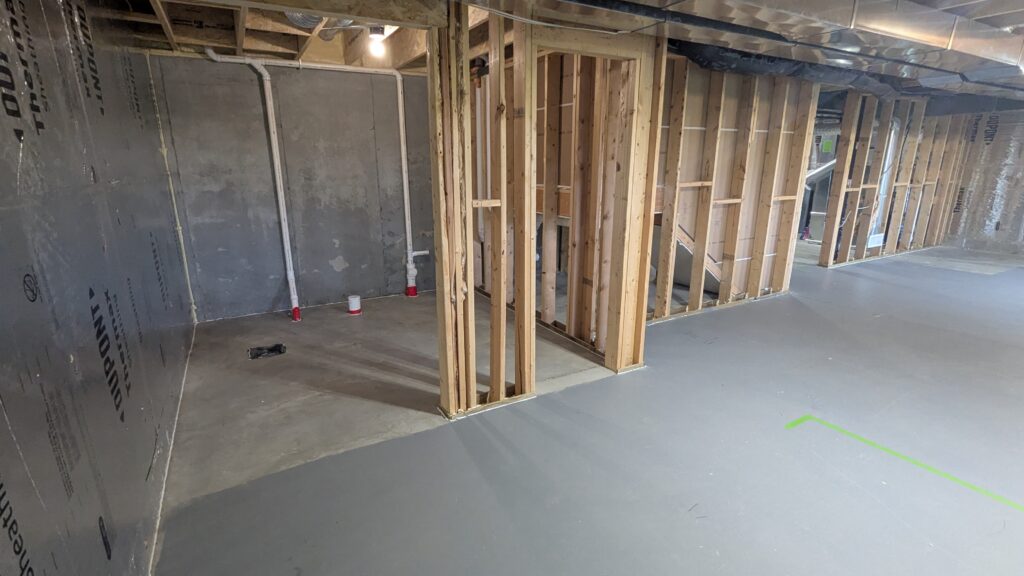
The first thing we do on any basement project is stand at the bottom of the stairs and look. Before measuring or sketching anything, we’re asking one question: what are we actually working with?
Some basements are a blank concrete box. Bare walls, a poured floor, a furnace tucked in one corner. Others were finished at some point, sometimes in 1987, sometimes by a previous owner who got halfway through and quit. Both are fine. They just lead to different plans and different budgets, and we’d rather you know which one you have before you start picturing the finished space.
Starting from the shell
An unfinished basement is a clean slate, and mostly that’s an upside. Framing, insulation, electrical, and flooring can all be planned around how you want to live down there, and nobody’s paying to tear out what someone else left behind.
Still, a blank slate comes with homework. We check for moisture, because a basement that wets through in April will wreck a nice floor. We look at ceiling height, since ductwork and plumbing stacks eat headroom fast. We note where the sump pump sits, where the panel is, and whether an egress window is possible if you want a legal bedroom. It’s boring work, but it saves you from the “oh, we didn’t know that was there” conversation halfway through.
When there’s already something to work with
A previously finished basement flips the question. Now it’s about what’s worth keeping. Maybe the walls are solid but the carpet is toast. Maybe there’s a bar from the early nineties you’d happily never see again.
Keeping what works is one of the easiest ways to stay on budget. We’re mid-range remodelers, and our clients want their money going toward things they’ll notice, so we’ll tell you honestly when something can stay. Sometimes we’ll tell you it can’t, usually when we open a wall and find a surprise. Better you hear it from us early.
The bathroom question
If a bathroom is on your wish list, this is where the project can swing the most, and it comes down to what’s underneath your feet. Is there a rough-in?
A rough-in is plumbing that was set in or under the slab when the house was built. Plenty of homes have a capped drain poking up through the floor somewhere, and some even have a toilet flange and a shower drain waiting patiently for decades.
If you have one, you’re in good shape. The hardest, messiest part of adding a bathroom has already been done. Nobody has to cut open the slab, dig a trench, set new pipe at the right slope, tie into the main line, and patch it all back up. That work is real labor, and it shows up on the invoice.
If you don’t have one, we can do that work. We’ve done it plenty. But it’s a different project with a different cost, and we want you to understand that before you fall in love with a spa shower in the corner. Concrete saws and hand digging in a finished-height basement aren’t cheap or quick.
So how do you find out? Look for round plugs, capped pipes, or squares of slightly different-colored concrete where a patch was poured, usually near the main stack. Check your home’s original plans if you have them. Or have us come out, because sometimes a ten-minute walkthrough settles it.
You aren’t locked into where the rough-in sits
Here’s the part that surprises people. Just because the drain is in the floor doesn’t mean the toilet has to go right on top of it.
Say the rough-in sits somewhere that doesn’t fit your layout, like the middle of the walkway. Moving it is often very doable. Shifting a drain six inches, or a foot, means cutting out a small section of slab, rerouting the pipe, and patching. That’s a far smaller job than creating a whole new drain line where nothing existed before, and it gets you a bathroom that works for the room instead of one bent around a pipe.
There are limits. Drains need a consistent slope, and distance from the main line matters. If the rough-in sits lower than your sewer line, an ejector pit and pump might come into play. That’s its own conversation, and we’ll walk you through it if it applies.
How we approach it with you
When a bathroom is in the plan, we find out what’s in the floor first. Then we sketch the layout you want and see how far it sits from what’s already there. After that, we price the easy version and the ideal version side by side so you can see the gap. Sometimes it’s small and clients go for the ideal. Other times they happily bend the layout to save money. Either answer is right.
We’re a family company out of Woodbury, and most of our work comes from people we’ve helped before or folks they’ve told about us. That only works if you feel good about the numbers from the start.
If you’re thinking about finishing your basement, or giving a tired one a second life, give us a call. We’ll take a look at what’s down there, rough-in included, and give you a straight read on where you stand. Call 651-735-8367 or use the Contact Card here.
